

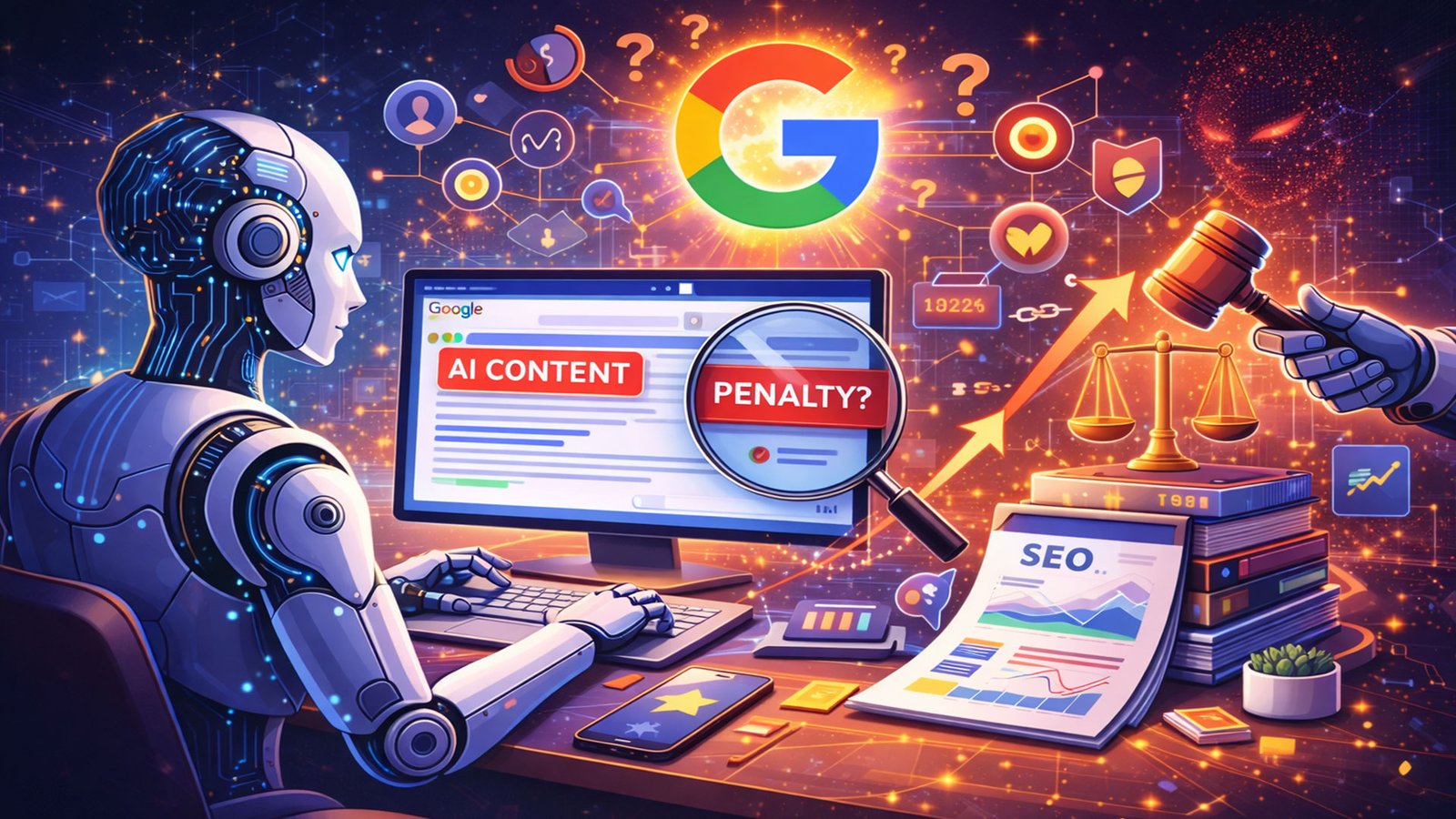
Artificial intelligence has reshaped the way content is created, optimized, and published online. In 2026, AI tools are no longer experimental-they are deeply embedded in SEO workflows, content marketing strategies, and editorial processes across industries.
Yet one question continues to dominate discussions among marketers, business owners, and SEOs:
Does Google penalize AI content?
Despite years of clarification from Google, misinformation, outdated opinions, and unreliable AI detection tools continue to fuel uncertainty. This article cuts through the noise with a fresh SEO case study perspective for 2026, analyzing Google’s policies, algorithm behavior, and real-world ranking patterns to deliver a clear, evidence-based answer.
Google’s Official Stance on AI Content in 2026
Google has consistently stated-and continues to reaffirm in 2026-that content is not ranked or penalized based on whether it was created by AI or a human.
What Google evaluates is the quality, usefulness, and intent of the content.
Automation, including AI, has been used in search for many years. Google itself relies heavily on advanced machine learning models to understand language, context, and user intent. As a result, the presence of AI in content creation is not inherently problematic.
The issue arises only when AI is used to:
- Mass-produce low-value pages
- Manipulate search rankings
- Publish content without meaningful human oversight
- Deliver information that lacks depth, accuracy, or originality
In short, AI is allowed-but abuse is not.
What Google Actually Penalizes (Regardless of AI)
Based on Google’s spam policies, Helpful Content System, and observed ranking behavior in 2026, penalties and ranking suppression typically occur when content demonstrates:
- Thin or surface-level coverage
- Repetitive or templated writing patterns
- Content created solely for SEO manipulation
- Pages that fail to satisfy search intent
- Low effort, low originality, or misleading information
These signals apply equally to human-written and AI-assisted content.
Google does not ask how content was created-it asks whether the content genuinely helps users.
New SEO Case Study Insights: AI Content Performance in 2026
Recent SEO case studies and SERP analysis reveal clear trends in how AI content performs today.
Key Observations from Ranking Data
- Pages using AI with human editing consistently outperform fully automated pages
- AI-only content with no expert input often struggles in competitive SERPs
- Content that demonstrates real-world experience ranks more reliably
- Improved quality leads to faster reindexing and ranking recovery
In 2026, Google’s algorithms are far better at identifying content that lacks effort or originality-even if it reads fluently.
Can Google Detect AI Content?
This is one of the most misunderstood aspects of modern SEO.
Google does not rely on public AI detection tools, nor does it penalize content based on AI probability scores. These tools frequently generate false positives and lack consistency.
Instead, Google focuses on behavioral and quality patterns, such as:
- Generic explanations with no unique insight
- Overly predictable sentence structures
- Poor engagement metrics
- Content that adds no new value to the topic
Rather than “detecting AI,” Google filters out content that behaves like low-effort automation.
Why Some AI Content Fails to Rank
When AI-generated or AI-assisted content underperforms, the root causes are almost always related to quality-not technology.
Common reasons include:
- No firsthand experience or original examples
- Weak alignment with search intent
- Overuse of generic phrasing
- Publishing at scale without editorial review
- Lack of topical authority or trust signals
In 2026, Google expects more than just correct information-it expects useful, credible, and thoughtfully created content.
EEAT in 2026: The Real Ranking Differentiator
Google’s EEAT framework-Experience, Expertise, Authoritativeness, and Trustworthiness-plays a central role in how AI content is evaluated.
AI can help with structure and efficiency, but it cannot:
- Replace lived experience
- Validate claims with real outcomes
- Establish authority on its own
- Build trust without human contribution
AI content that ranks well in 2026 typically includes:
- Human editorial review
- Demonstrated subject knowledge
- Real examples, data, or case insights
- Clear purpose aligned with user needs
Is AI Content Still Safe for SEO in 2026?
Yes-when used responsibly.
In 2026, successful SEO teams treat AI as:
- A research assistant
- A drafting and ideation tool
- A productivity enhancer
But never as a replacement for expertise or intent.
The most effective strategies combine AI efficiency with human judgment, originality, and experience-exactly what Google’s people-first guidelines encourage.
Best Practices for Ranking AI Content in 2026
To ensure AI-assisted content performs well and remains future-proof, follow these principles:
- Prioritize Search Intent
Understand what users truly want before creating content.
- Add Net-New Value
Go beyond summarizing existing information. Share insights competitors don’t offer.
- Maintain Strong Editorial Control
Every AI draft should be reviewed, refined, and improved by a human.
- Avoid Low-Effort Content at Scale
Publishing large volumes without depth is one of the fastest ways to lose visibility.
- Optimize for Humans, Not AI Detectors
AI detection scores have no ranking value. User satisfaction does.
Final Verdict: Does Google Penalize AI Content in 2026?
No-Google does not penalize AI content simply because it is AI-generated.
What Google penalizes is:
- Low-quality content
- Manipulative automation
- Pages that fail to help users
Whether content is written by AI, a human, or a combination of both, it is judged by the same standards.
In 2026, the real question is no longer “Is AI allowed?”
It’s “Does this content genuinely deserve to rank?”
AI is a tool-not a shortcut. When used thoughtfully, it can support high-performing SEO content. When misused, it exposes weaknesses faster than ever.
The future of SEO belongs to those who use AI to create better content, not just more content.